The Sound of Silence
In Egyptian metaphysics, Hu was the creative utterance.
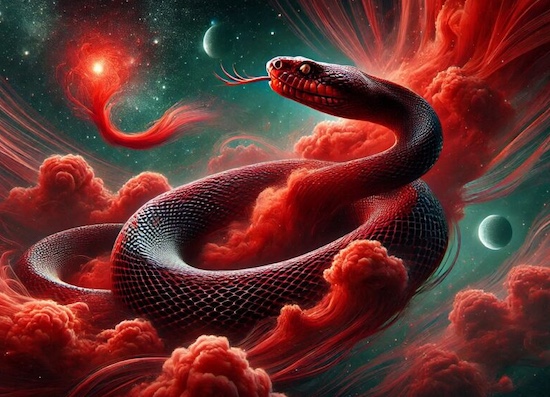
In the Book of the Dead, Ra was said to have ascended from the primordial waters as a snake. As self-created deity, He was the first being to emerge from the total darkness and watery abyss that existed before creation. A product of the order within this chaos, Ra was the first to speak the creative “Hu”.
This was the word through which consciousness expressed itself. When viewed symbolically, the term hu-man could be read as “the one who carries or embodies Hu.” In this interpretation, a human being is understood as a vessel through which the cosmic creative utterance becomes conscious of itself.

The primordial vibration, Hu, is the sound of silence from which all existence emerges. From the sacred hum all forms unfold. It evokes the idea that vibration itself is the origin of matter. In this cosmology, the first “word” or “tone” is what calls the universe into being—a logos that structures energy into order. In this view, the human being becomes the microcosmic expression of that cosmic utterance—Ra’s Word made flesh.
Sia was “light” and often depicted as accompanying Ra on his journey through the sky. Where Hu is the raw sound energy, Sia is the faculty that perceives, interprets and channels that energy into intelligible form. As the “Light of Ra” it was the principle by which cosmic intelligence becomes Self-aware.

Above: His right eye was the Sun and His left the Moon
Red in Egyptian symbology was deshret—the colour of conscious life, inner fire and manifest power. The disc above the head of a god wasn’t so much “something beyond” as it was the creative source. In a sense, it corresponded to the Eye of Ra, or this god’s living vision. It was the beginning and the end of all energy.
I am the one who calls the universe into being.
Placing red there tells us that the highest point of consciousness is not something new, exotic or abstract. It is the living spark of existence itself, fully realised and contained. Its placement above the head shows that the summit of awareness is not elsewhere—it is the living energy that animates all things. Consciousness culminates as life itself—where the personal and the universal are simultaneously both and one.

Ra was the king of all the other deities. So powerful was He that some have argued that the entire Egyptian religion was some form of veiled monotheism. This seems to be an overstatement, but it underlines Ra’s primary position within the religious texts. Here we are reminded of His secret Latin initialism SSSS:
SERMONE SACRO SPHAERAM STATUI
By the sacred word I have created the sphere
This phrase isn’t misunderstood because it’s confusing—but because it’s powerful. It challenges the boundaries between word and world, language and logos, self and Self. To the zealot it may seem blasphemous, but to the mystic it reveals the truth.

But Ra wasn’t just speaking metaphorically above. He was describing the secret matrix that the Melchizedek Order used to create self-aware planets throughout the universe. In other words, the ancient mysteries weren’t lost—they’re still active, waiting for us to rediscover them.
THE INVOCATION OF THE SACRED WORD
By power unseen, by pulse of flame,
By breath that moves and speaks the Name,
I summon stars from silent womb—
From void to voice, from light to bloom.
With living word, not carved in stone,
But forged in fire, in thought alone,
I wove the weave, I turned the key,
I sang the world to life through me.
I am the seed within the flame,
The breath that speaks the hidden name.
In every dawn, in every part—
The Sun ascends within the heart.
I am the Word. I am the Way.
I am the dawn of every day.
So let it be as it was begun—
The Duo who knows that all is One.
So these myths are not records of events but rather maps of consciousness. Ra rising from the waters is not about the past—it’s about you, now, rising from unconsciousness into awareness. “In the beginning was the Word” describes the universe’s rebirth in every moment of your own becoming—in every thought, in every word, in every deed.